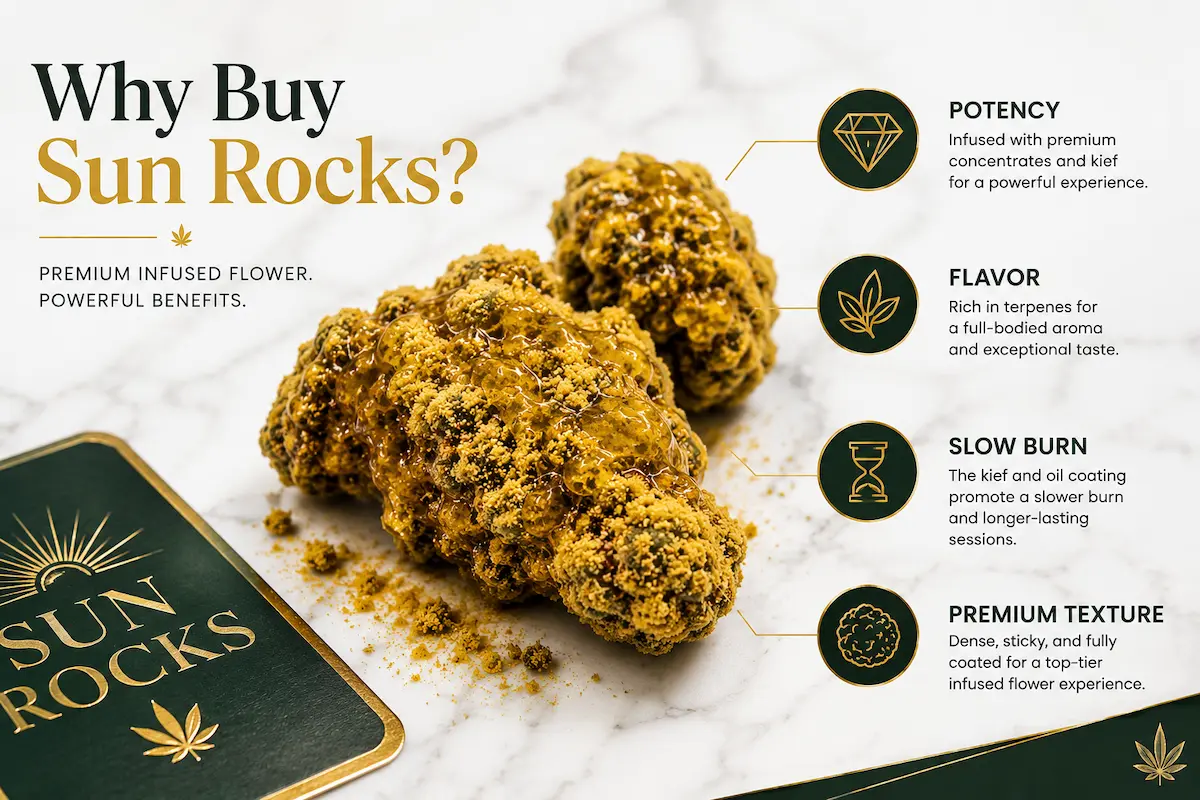
What Are Sun Rocks? A Complete Cannabis Guide to How They’re Made
Sun Rocks show up on a lot of dispensary menus and delivery apps lately. Brands often describe them as “ultra-potent” or “premium infused flower.” But what are they, really? How do makers build them? And how do they compare to Moonrocks? This guide answers all three questions in plain language, so you know exactly what you’re looking at before you buy.
Table of Contents
- What Are Sun Rocks?
- Where the Name Comes From
- How Producers Make Sun Rocks, Step by Step
- What Goes Into Each Layer
- Sun Rocks vs. Moonrocks: What’s the Difference?
- Sun Rocks vs. Other Concentrate-Flower Products
- Why the COA Matters More for Sun Rocks
- How to Read a Sun Rocks COA
- How to Store Sun Rocks
- How People Typically Use Sun Rocks
- What to Look for When Buying Sun Rocks
- Red Flags to Avoid
- Are Sun Rocks Legal in California?
- Common Myths About Sun Rocks
- What to Expect, Generally
- Frequently Asked Questions
What Are Sun Rocks?
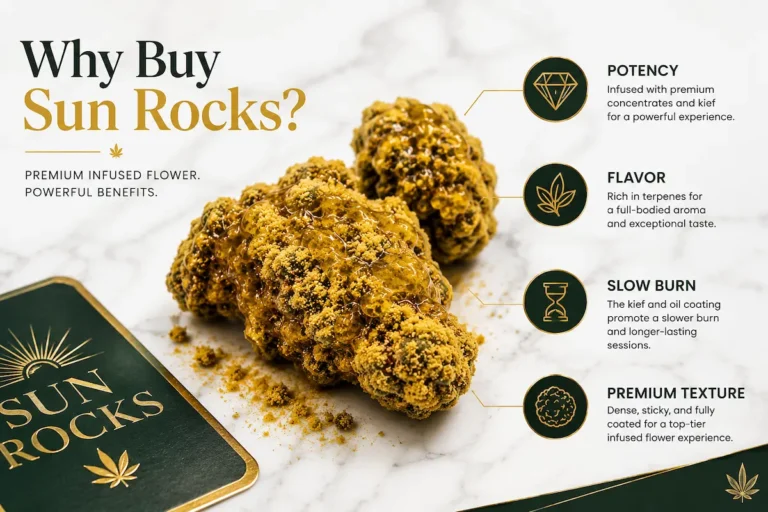
Sun Rocks are a type of concentrate-enhanced cannabis flower. Producers coat a cannabis bud in cannabis oil — often live resin or a similar concentrate. Then they roll it in kief, the fine, resinous trichomes that fall off dried cannabis flower during handling. The result is a dense, sticky, high-potency bud. It looks noticeably different from regular flower. You’re meant to break it apart before use, not smoke it whole like a standard pre-roll or bowl pack.
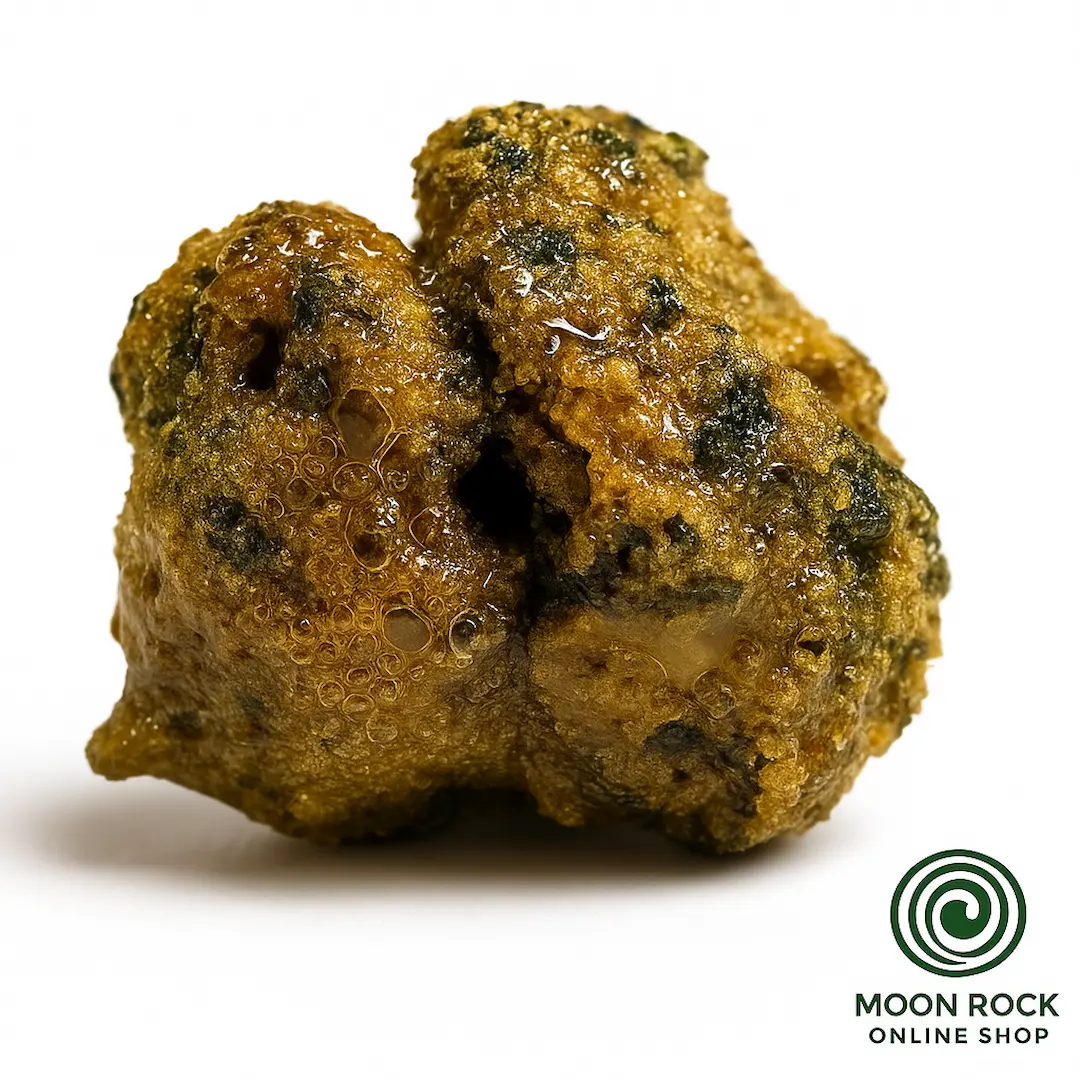
Three separate cannabis products go into one bud, so Sun Rocks land in a different potency category than regular flower entirely. That’s why brands market them toward experienced consumers rather than beginners. It’s also why understanding what’s actually inside one matters more than it does with a standard eighth of flower.
Where the Name Comes From
Naming in this product category is genuinely inconsistent across the industry. It’s worth knowing that upfront, so you don’t assume too much from a label alone.
“Moonrocks” is the older, more widely recognized term. Most people credit it to a cannabis industry collaboration roughly a decade ago that popularized the three-layer flower-oil-kief format. “Sun Rocks” emerged later, as brands looked for a related but distinct name. Sometimes the new name signals a lighter or brighter flower base. Sometimes it signals a different production method. Often, though, it’s simply a branding choice with no technical difference at all.
No regulatory body standardizes what “Sun Rocks” has to mean, unlike a term such as “organic” in food labeling. So the name alone doesn’t guarantee a specific potency range, base strain type, or production process. Two products, both labeled “Sun Rocks” from two different companies, could turn out to be meaningfully different. This is the single most important thing to understand before reading further: treat “Sun Rocks” as a category name, not a guaranteed spec sheet.
How Producers Make Sun Rocks, Step by Step
At a high level, three layered components go on in sequence:
- A base bud. Production starts with a full, well-cured flower — not shake, not trim. Producers pick an intact bud specifically because it holds together well once coated. This bud becomes the structural foundation everything else sticks to.
- A cannabis oil coating. Workers brush, dip, or spray the bud with a cannabis oil concentrate. This might be live resin, hash oil, rosin, or another extract, depending on the producer. Because concentrates carry much higher cannabinoid density than flower alone, this layer adds a large share of the finished potency.
- A kief coating. Once the oil layer turns tacky, workers roll the bud in kief — the powdery, resin-rich trichomes sifted from dried flower — until it’s fully coated. This final layer gives Sun Rocks their signature golden, crystalline look. It also adds a third source of cannabinoids and terpenes to the finished product.
Because of this three-layer build, potency comes from three separate cannabis sources stacked on one bud, not from the flower alone. So quality control at each individual layer — the flower, the oil, and the kief — actually determines how good the finished product is, not just the strain name on the package.
What Goes Into Each Layer
Each layer deserves a closer look, since quality differences at any single stage affect the whole product.
The base flower should be a full, intact, well-cured bud. Lower-quality producers sometimes use smaller or lower-grade buds as a base, since coating hides them anyway. Even so, a poor base flower still affects burn quality, flavor, and structural integrity once coated.
The oil layer varies the most between brands. Live resin, made from flash-frozen fresh cannabis, tends to preserve terpenes more effectively than oil made from dried, cured material. That difference can translate into a more distinct flavor and aroma in the finished product. Other producers use standard hash oil or rosin instead. Both are legitimate concentrates, but each carries a different flavor and cannabinoid profile.
The kief layer is the most visually obvious layer, but it’s also the easiest to fake with lower-quality material. High-quality kief looks fine, dry, and pale gold to amber in color. Lower-quality kief can include plant matter contamination, which hurts both flavor and smoothness. This is one more reason a COA covering the finished product — not just the base flower — matters so much for this category.
Sun Rocks vs. Moonrocks: What’s the Difference?
Producers build both products the same way, but the details vary by brand. Treat any specific numbers below as brand-specific, not an industry standard:
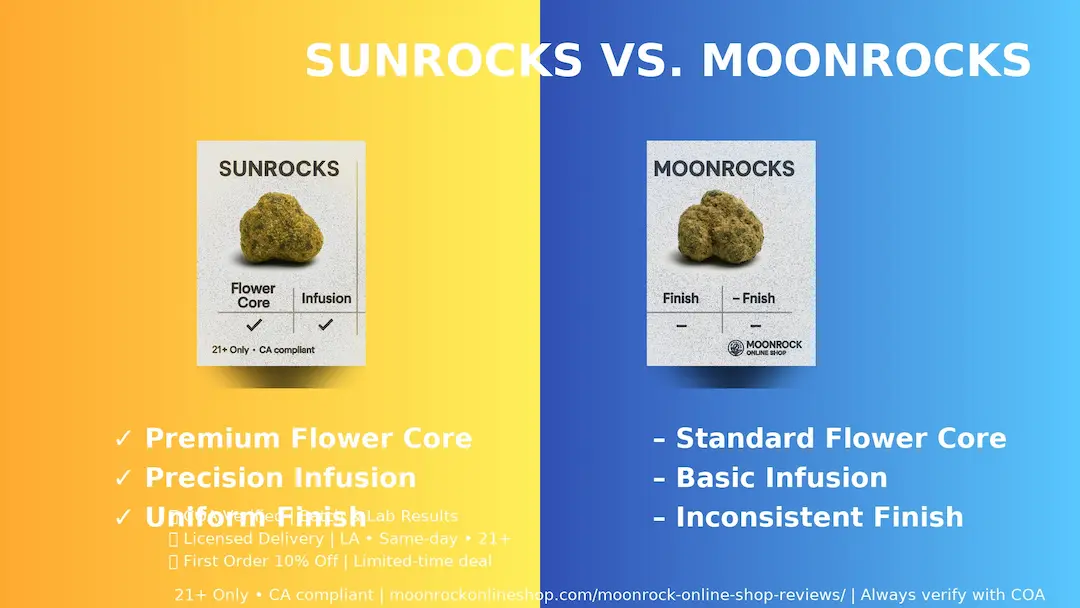
- Base flower: Moonrocks traditionally use an indica-leaning base bud. Sun Rocks more often use a sativa or hybrid base, though this varies by producer and isn’t a hard rule.
- Density: Sun Rocks tend to be a bit lighter and less densely packed than a classic Moonrock, which some brands coat more heavily.
- Potency range: As one example, Moonrock Online Shop lists its Sun Rocks around 60–80%+ THC, versus roughly 40–60% for its Moonrocks. But these ranges are brand-specific, not universal, so always check the COA instead of assuming a number based on the product name.
- Naming isn’t standardized. Some brands use “Sun Rocks” and “Moonrocks” almost interchangeably. Others use different names for what’s functionally the same process. Checking the product’s COA and description is the only reliable way to know what you’re actually getting.
Sun Rocks vs. Other Concentrate-Flower Products
Sun Rocks sit inside a broader category of concentrate-enhanced flower products. People sometimes call these “infused flower” or, informally, “cannabis caviar.” Moon rocks, caviar-coated pre-rolls, and various brand-specific names all fall under this same general format. What separates a genuinely well-made product from a lower-quality one usually isn’t the name. It’s whether all three layers — flower, oil, kief — are high quality, and whether real lab testing backs up the finished product.
If you spot an unfamiliar brand-specific name in this same general category, ask the same questions regardless of what it’s called: What’s the base flower? What type of oil did they use? Is the kief clean? Is there a COA for the finished product?
Why the COA Matters More for Sun Rocks
Because Sun Rocks combine three separate cannabis products into one item, potency swings between batches — and between brands — run larger than with regular flower. A product like this needs a Certificate of Analysis (COA) that covers the finished product, not just the base flower, plus contaminant testing specific to the oil and kief layers.
Before buying Sun Rocks from any retailer, ask:
- Is there a COA available for this specific batch, not just a general product page?
- Does the COA test the finished, coated product, or only the base flower before coating?
- Did testing cover pesticides, residual solvents, and heavy metals, not just cannabinoid potency?
- Is the testing lab named and independently licensed, rather than an in-house or unnamed lab?
A licensed retailer will have this information ready and should walk you through it without hesitation. If a seller can’t produce it, or gets vague when you ask, treat that as a real warning sign rather than a small detail to overlook.
How to Read a Sun Rocks COA
A Certificate of Analysis can look intimidating at first. Still, a few key sections are worth learning to find.
Cannabinoid potency. This section lists percentages for THC, CBD, and sometimes minor cannabinoids like CBG or CBN. For a layered product like Sun Rocks, confirm the lab tested the finished product. Testing only the base flower would understate the actual potency significantly.
Contaminant screening. This section covers pesticides, residual solvents (relevant if the oil layer used a solvent-based extraction), heavy metals, and microbial contaminants like mold or bacteria. A passing result should appear clearly, not just be implied.
Batch and date information. Every legitimate COA ties to a specific batch number and testing date, not a general product line. If the batch number on your COA doesn’t match the batch number on your actual package, flag that with the retailer directly.
How to Store Sun Rocks
Sun Rocks are sticky and fragile because of the oil and kief layers, so they need different handling than regular dried flower. A few basics actually matter here:
- Keep them in an airtight, opaque container, away from light and heat, since both degrade cannabinoids and terpenes over time
- Avoid handling them more than necessary — the kief layer sheds easily, and repeated handling wastes potency along with the loose kief
- Store at room temperature in most cases. Some sources recommend short-term cool, dark storage, but avoid refrigeration for extended periods, since moisture from temperature swings can affect texture and encourage mold
- Use a dedicated container rather than a grinder. A grinder will jam with the sticky oil layer and waste material
How People Typically Use Sun Rocks
Sun Rocks are dense and sticky, so people don’t roll or pack them the way they’d pack regular flower. Most break them apart carefully with fingers or scissors, rather than a standard grinder, since the oil coating gums up grinder teeth and wastes product. They typically mix small broken pieces into flower in a pipe, bong, or rolling paper, rather than using a whole rock at once — partly for practical handling reasons, and partly because of the higher potency involved.
Because potency runs higher than regular flower, pacing consumption matters more here than with standard products. This is general information about how the format gets handled, not dosing advice. How much is appropriate varies by person, tolerance, and the specific product’s tested potency — and that isn’t something a general guide can responsibly specify.
What to Look for When Buying Sun Rocks
A few practical things separate a well-made product from a lower-quality one at the point of purchase:
- A visible, batch-specific COA, rather than a generic potency claim on the packaging
- Clear ingredient sourcing. Some brands note the base strain, oil type, and kief source; more transparency generally signals more confidence in the product
- Even coating. Visually, a well-made Sun Rock should show consistent oil and kief coverage, not patchy bare spots or overly saturated, mushy sections
- A licensed retailer. Buying through a licensed dispensary or delivery service means the product passed California’s mandatory testing requirements before it reached you
Red Flags to Avoid
A few signs suggest a product — or a seller — isn’t what it claims to be:
- No COA on request, or a COA that doesn’t match the batch number on the package
- Pricing dramatically lower than comparable products, which often signals cut corners in sourcing or testing
- Vague or evasive answers when you ask directly about the oil type or kief source
- No listed license number for the retailer, which California requires for legal cannabis businesses
- Packaging that’s inconsistent between orders from the same seller, which can point to inconsistent sourcing or, worse, an unlicensed operation
Are Sun Rocks Legal in California?
Sun Rocks aren’t a distinct legal category. Regulators treat them the same way as any cannabis flower product under California’s cannabis laws, overseen by the California Department of Cannabis Control. So a legitimate Sun Rocks product sold in California has to go through the same mandatory lab testing, packaging, and licensing requirements as any other cannabis product. That’s exactly why the COA and license-number questions in this guide matter so much. Buying from an unlicensed source doesn’t just carry legal risk for the buyer in some cases — it also skips the testing requirements built specifically to catch contamination and mislabeled potency.
Common Myths About Sun Rocks
A few misconceptions show up often enough to address directly.
“Sun Rocks are always stronger than Moonrocks.” Not necessarily true. Potency depends on the specific ingredients and process a brand uses, not on which of the two names sits on the label. Some brands’ Moonrocks test higher than their own Sun Rocks. The name is a branding choice, not a potency guarantee.
“If it’s shiny and gold, it’s high quality.” Appearance is one signal among several, but it isn’t proof of quality by itself. A heavy coating can disguise a lower-quality base bud underneath. A COA tells you far more than the visual coating does.
“Sun Rocks and caviar are completely different products.” In most cases, “cannabis caviar” is simply another name for the same general concentrate-and-kief-coated flower format. The naming varies more than the underlying product does.
“More layers always means more effect for your money.” Not automatically. A product built on a poor base bud, low-quality oil, or contaminated kief can test lower in practice than a simpler but well-made product, no matter how many layers it has.
What to Expect, Generally
Because Sun Rocks combine three separate cannabis sources, people used to regular flower often notice the effects arrive differently than they’re used to. This varies by individual and by the specific product’s tested potency, so treat it as general context rather than a promise of any particular experience. Oil type, individual tolerance, and how you consume the product all shape the outcome. That’s part of why experienced consumers pace themselves with an unfamiliar batch, and why checking a product’s actual tested potency on its COA tells you more than relying on general expectations for the category alone.
Frequently Asked Questions
What are Sun Rocks, in simple terms? A cannabis bud coated in cannabis oil, then rolled in kief, creating a three-layer, high-potency product that’s different from regular flower.
Are Sun Rocks stronger than regular flower? Generally yes, since they combine flower, concentrate, and kief in one product. Exact potency varies by producer and batch, so check the COA rather than trusting the name alone.
Are Sun Rocks stronger than Moonrocks? Not necessarily. Potency depends on the specific brand’s process and ingredients, not the name. Some brands’ Sun Rocks test higher than their Moonrocks; that isn’t universal across the industry.
Can I smoke a Sun Rock whole? Most people break them into smaller pieces first, using fingers or scissors rather than a grinder, then combine the pieces with regular flower rather than smoking a whole rock at once.
Do Sun Rocks expire? Cannabis products degrade over time rather than spoiling outright the way food does. Proper storage — airtight, cool, dark — slows that degradation and helps preserve potency, flavor, and texture longer.
Are Sun Rocks and Moonrocks the same thing? Producers build both using the same three-layer method, but they often differ in base flower, density, and branding. Naming varies by brand, so check the COA and product description rather than relying on the name alone.
What’s the difference between Sun Rocks and regular infused pre-rolls? Infused pre-rolls typically mix oil or kief into ground flower before rolling. Sun Rocks keep an intact base bud coated on the outside instead. As a result, handling and potency profile differ between the two.
Is it safe to buy Sun Rocks online? It can be, as long as you buy from a licensed California retailer with visible licensing information and batch-specific lab testing available. The same red flags that apply to any online cannabis purchase apply here too: no COA, no license number, and prices that seem too good to be true are all reasons to pause.
Explore More
- Buy Sun Rocks
- Sun Rocks vs Moon Rocks — Full Comparison
- What Are Moonrocks?
- What Is Kief? Full Guide
- Moonrocks vs Sunrocks (CBD)
- How to Order Cannabis Online
Moonrock Online Shop | Licensed Cannabis Retailer, California | License: [LICENSE NUMBER] | Adults 21+ only. This content is for educational purposes and is not medical advice. Products intended for California residents in areas where delivery is permitted.