How to Spot a Non-Licensed Cannabis Website: A Full Dissection (2026)
Meet GreenLeafExample420.com.
It doesn’t exist — we built it as a composite from dozens of real scam sites reported to consumer protection agencies over the past two years. But you’ve seen it. Clean layout. Jars of glistening flower. A “4.9 stars from 2,300 customers” badge. Discreet nationwide shipping. 30% off your first order, today only.
It is a non-licensed cannabis website, and it will take your money, your ID photo, or both.
Instead of handing you another listicle, we’re going to put this specimen on the table and dissect it — homepage, product page, checkout, footer, contact page — and show you exactly where a fake online dispensary gives itself away. By the end, you’ll be able to run this same dissection on any cannabis site in under five minutes.
One note before we cut: several of the top-ranked “how to spot a fake dispensary” guides on Google are published by unlicensed nationwide-shipping sites themselves — the foxes writing guides to henhouse security. That’s how deep this problem runs. Treat every guide, including this one, as unverified until you’ve checked the author’s license. Ours is in the footer of every page, verifiable at the California Department of Cannabis Control in 60 seconds. Do it. That habit is the entire lesson of this article.
Scalpel ready. Let’s open it up.
Organ 1: The Homepage — Where the Lie Is Loudest
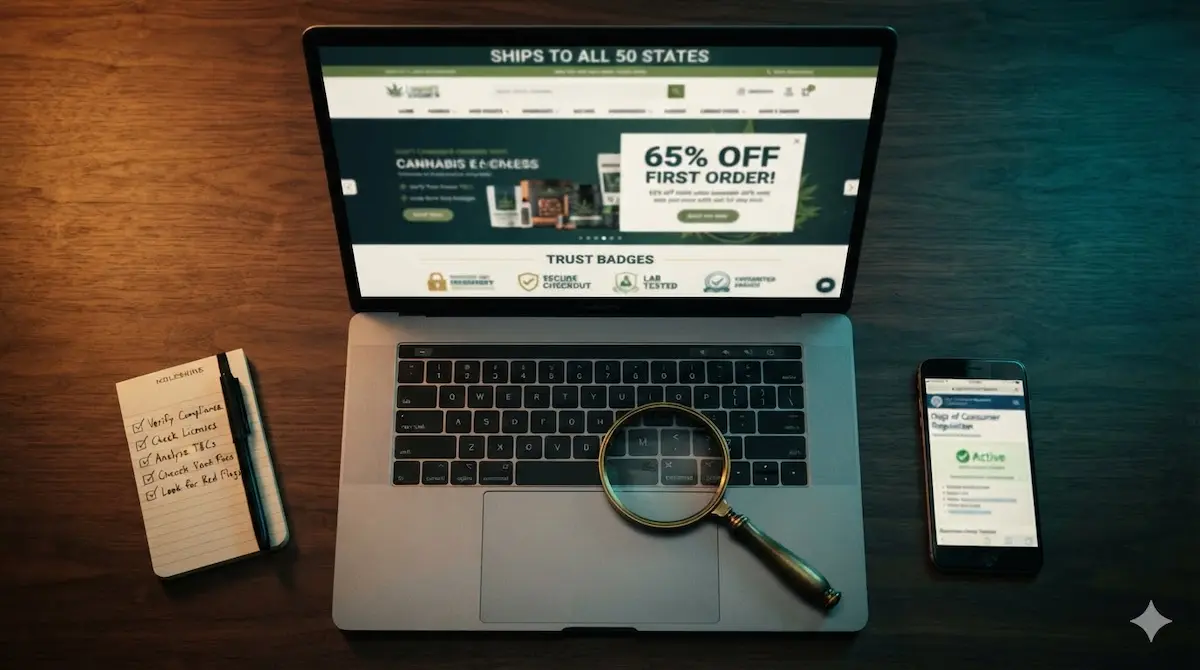
The homepage of a non-licensed cannabis website is engineered to borrow trust it hasn’t earned. Most unlicensed cannabis website red flags cluster right here, above the fold, where the persuasion budget gets spent. Here’s what our specimen shows, and what each element actually means.
“We ship to all 50 states”
Stop. This is the kill shot — the single unlicensed cannabis website red flags item that ends the dissection before it starts.
Cannabis remains federally illegal to ship across state lines. No state license — not California’s, not New York’s, not anyone’s — permits interstate shipping of THC cannabis. A licensed dispensary can deliver within its licensed state, inside its licensed zones, full stop. Any site promising nationwide THC delivery is telling you, in its own headline, that it operates outside every regulatory system in the country. However, check our terms and conditions before shopping
Roughly nine out of ten fake sites can be identified by this claim alone. If you learn nothing else about how to verify a dispensary website, learn this sentence.
Verdict: fatal. No further examination required. But we’ll keep cutting for the education.
The trust badges
Our specimen displays “Verified by TrustShield,” “100% Money-Back Guarantee,” and a BBB-style torch icon. None of them are links. Real accreditation badges click through to a verification page on the accreditor’s site. Scam badges are JPEGs. Click every badge on any site you’re vetting — a badge that goes nowhere is decoration, not verification.
The urgency machinery
A countdown timer (“Sale ends in 04:37:12”), a “Only 3 left!” stock warning, and a popup offering 30% off for the next ten minutes. Licensed retailers run promotions, but they’re constrained by state advertising rules and they don’t need artificial panic. Urgency machinery exists to compress the time between your arrival and your payment — the window where you’d otherwise do exactly what this article teaches.
Verdict: three strikes on one homepage. In a real dissection, you’d have closed the tab already.
Organ 2: The Product Page — Stolen Photography and Impossible Numbers
Scroll into our specimen’s menu and the fake online dispensary pattern continues, just quieter.
The photos aren’t theirs
Right-click any product photo and search it with Google Lens or TinEye. On scam sites, the same glistening jar of “Gelato 41” appears on eleven other websites, three Reddit posts, and a licensed brand’s Instagram from 2023. Fake sites don’t have product because they don’t have inventory — they have a photo library scraped from real operators.
Reverse-image search is the single most underused weapon in the how to verify a dispensary website toolkit. It takes fifteen seconds and it is nearly impossible for a scammer to defend against, because taking original photography requires owning actual product.
The numbers don’t survive arithmetic
Our specimen sells “top-shelf, lab-tested, 38% THC flower” at $89 an ounce, every strain, every day. Two problems. First, 38% THC flower is vanishingly rare — most genuinely premium flower tests between 18% and 28%, and labs flag most claims above 30% as inflated. Second, $89/oz for top-shelf is below the wholesale cost of legally produced, tested, taxed cannabis. The price isn’t a deal. It’s an admission that no real product is changing hands, or that whatever ships is untested gray-market flower wearing a costume.
The COA that proves nothing
The specimen links a “Lab Report” PDF. It’s a generic certificate with no batch number, a lab name that returns zero Google results, and results too clean to be real (0.00% moisture — physically impossible for cured flower). A real certificate of analysis carries a batch number that matches the product packaging, names a state-licensed lab you can find on your regulator’s website, and is usually verifiable by QR code directly at the lab’s own domain. Fail any leg of that tripod and the COA is a prop.
Verdict: stolen photos + impossible pricing + prop COA. The product page is a stage set.
Organ 3: The Checkout — Where Every Cannabis Website Scam Converges
Everything upstream was persuasion. The checkout is extraction. This is where the specimen — like every cannabis website scam running on a non-licensed cannabis website — shows its actual business model.
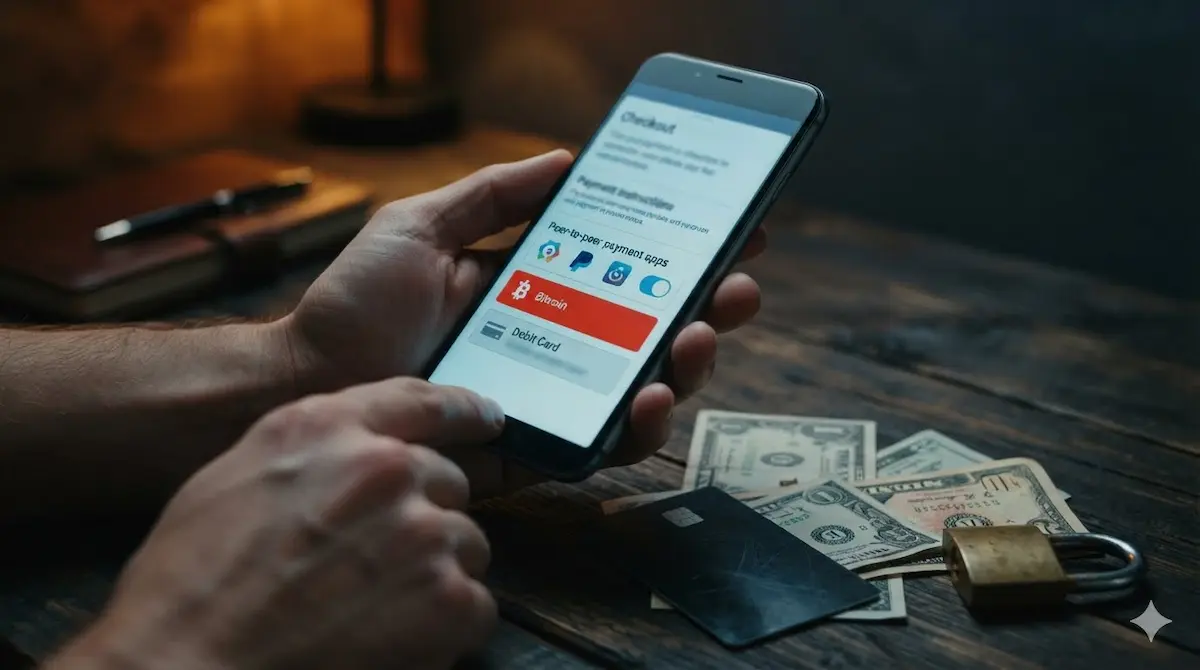
The payment-rail decoder
What a site asks you to pay with is the most honest thing on it. Payment rails don’t lie, because they’re determined by what payment processors will tolerate — and no legitimate processor touches unlicensed cannabis.
| Payment method requested | What it means |
|---|---|
| Zelle, CashApp, Venmo only | No processor will touch them. Zero fraud protection. Classic cannabis website scam rail. |
| Bitcoin / crypto only | Irreversible by design. Walk away. |
| Gift cards (Apple, Amazon, Vanilla) | Not even pretending. This is the same rail as IRS phone scams. |
| Wire transfer | Irreversible, untraceable, disqualifying. |
| Debit at checkout or door, cash on delivery, ACH (Aeropay/Hypur) | The rails licensed dispensaries actually use. |
Here’s the cannabis-specific nuance generic scam guides miss: consumer-protection agencies advise paying by credit card for chargeback rights — but most licensed dispensaries can’t accept credit cards, because card networks still restrict cannabis. So the tell isn’t “no credit cards.” The tell is peer-to-peer-only or crypto-only, paired with everything else in this dissection.
The fee ambush
The signature move documented across hundreds of consumer complaints: you pay, then the “dispensary” contacts you demanding an additional fee — <cite index=”2-1″>” delivery insurance,” or a charge described as “standard for all new clients”</cite> — often around $200, with a promise it’s refunded on delivery. There is no delivery. The fee ambush repeats as long as you keep paying. The Better Business Bureau has an active alert on exactly this pattern.
The ID photo request
The specimen’s checkout asks you to upload a photo of your driver’s license “for age verification.” A licensed shop verifies age through an integrated verification service at checkout and a physical ID scan at handoff — it doesn’t warehouse a JPEG of your license sent before any transaction. A scam site wants that image for downstream identity fraud; a clean U.S. ID with a matching selfie resells for real money. We covered the full downstream in the real risks of buying cannabis on social media, and the operator side in why age verification matters for online cannabis orders.
Verdict: The checkout is the scam. Everything else was set dressing.
Organ 4: The Footer — Where the License Should Be
Scroll to the bottom of any cannabis site, and you’re looking at the most legally consequential real estate on the page. On a licensed retailer’s site, the footer carries a state license number — in California, a string like “C9-0000123-LIC.” On a non-licensed cannabis website, the footer is where the costume runs out of fabric. Our specimen shows: a copyright line, a Telegram icon, and the words “100% Legal & Discreet.”
The 60-second license lookup
This is the core of every legit online dispensary checklist, the heart of how to verify a dispensary website, and the one check that cannot be faked:
- Find the license number in the footer (no number = dissection over).
- Open your state regulator’s license search ,in California, the Department of Cannabis Control’s search tool.
- Paste the number. Check three fields: status (must be Active), license type (retail/delivery), and business name (must match the site).
A fake online dispensary fails this in one of three ways: no number at all, an invented number that returns nothing, or a real number stolen from a legitimate shop — which the name-match catches. Sixty seconds, three fields, done.
Every major legal state runs an equivalent public database: California’s DCC, New York’s OCM, Michigan’s CRA, Massachusetts’ CCC, Colorado’s MED, Nevada’s CCB. Search “[your state] cannabis license lookup” and use only the .gov result.
The domain tells
Two more footer-adjacent checks while you’re down here. Run the domain through a WHOIS lookup — scam domains are typically under a year old, because they get reported and burned, then relaunch under a new name. And check the URL spelling character by character: cloned sites live one letter away from the real operator they’re impersonating.
Verdict: No license number in the footer is not a yellow flag. It’s the whole diagnosis.
Organ 5: The Contact Page | Accountability Check
Last organ, our specimen’s contact page offers a contact form and a Telegram handle. Ho No phone number. No physical address. No named humans.
A licensed retailer is findable in the physical world because the state requires it — a licensed premises address, a working phone line, support staff who answer before and after you pay. A non-licensed cannabis website is engineered for the opposite: maximum payment surface, minimum accountability surface. One sharp way to test it: contact support with a pre-purchase question and see what happens. Real shops answer questions. Scam sites accept payments.
If the only way to reach a “dispensary” is a messaging app, you’re not looking at a dispensary. You’re looking at the web storefront of the same operation we dissected in the social media piece.
Verdict: unreachable by design. Specimen confirmed dead on arrival.
The Full Dissection Protocol — Your Legit Online Dispensary Checklist
Here’s the whole procedure compressed into a repeatable legit online dispensary checklist, every unlicensed cannabis website red flags category from the dissection, ordered by lethality. Run it top to bottom on any new site; stop at the first fatal finding.
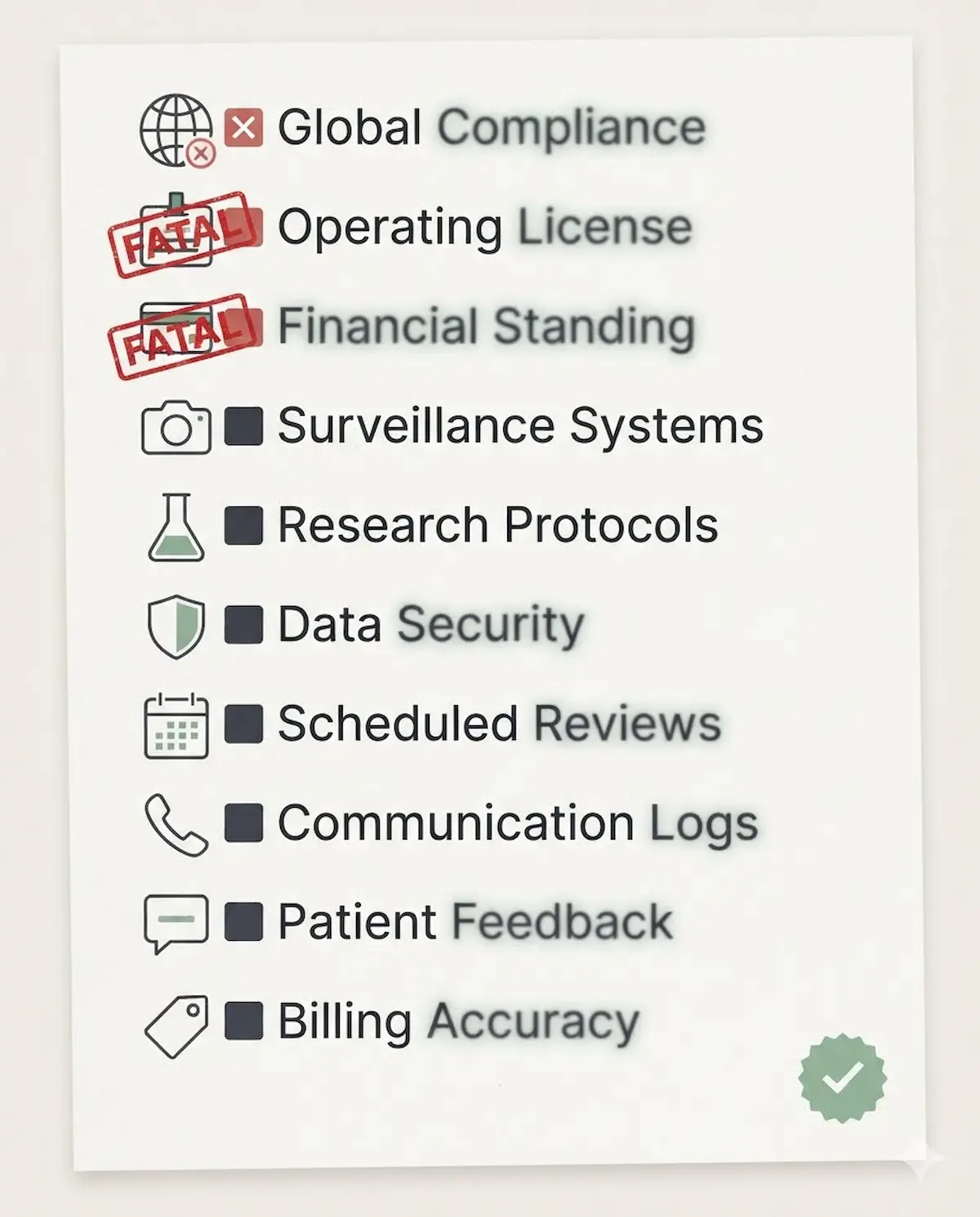
- Nationwide shipping claim? Fatal. Close the tab.
- License number in the footer? Missing = fatal. Present = verify it (status, type, name match) at the state regulator’s .gov search.
- Payment rails: Zelle/CashApp/crypto/gift-card only = fatal. Debit, cash on delivery, or ACH = consistent with licensed.
- Reverse-image search two product photos. Stolen photography = fatal.
- Open a COA: batch number matches packaging, lab is state-licensed, results verifiable at the lab’s own site. Any leg fails = treat as fake.
- Click every trust badge. Non-clickable badges = decoration.
- WHOIS the domain. Under a year old + any other flag = walk.
- Find a phone number and physical address. Messaging-app-only contact = fatal.
- Ask support a question before paying. No answer = your money would get the same treatment.
- Price sanity check. Below-wholesale pricing on “top-shelf” product is an admission, not a discount.
Print it, screenshot it, save it. This legit online dispensary checklist is deliberately ordered — the fatal checks come first, so most dissections take under a minute.
Why Fake Sites Outrank Real Ones
A fair question at this point: if these sites are so obviously fraudulent under dissection, why do they fill your search results?
Because the playing field is tilted. Licensed cannabis retailers are heavily restricted in where and how they can advertise ,Google Ads and most major ad networks prohibit THC promotion, and state rules constrain the rest. A non-licensed cannabis website ignores all of it. Scam operations buy ads, spin up SEO content farms, publish their own “how to avoid scams” guides, and relaunch under fresh domains every time one gets burned. The result is a search landscape where the sites this article teaches you to dissect are often flying at the top of page one, above the licensed shops that can’t legally compete for the same ad space, which is exactly why knowing how to verify a dispensary website yourself matters more than trusting any ranking.
That’s also why the strongest signal isn’t ranking, reviews, or design polish. It’s the one thing a scammer can’t buy: an Active license in a government database. Every other element of a cannabis website scam can be faked in an afternoon. The license can’t.
Frequently Asked Questions
Are online dispensaries that ship to all 50 states legal?
No. Interstate shipping of THC cannabis is federally prohibited, and no state license authorizes it. Every site making this claim is a non-licensed cannabis website by definition, regardless of how professional it looks.
How do I verify a dispensary’s license number?
Footer → state regulator’s .gov license search → check status (Active), license type, and business-name match. In California, that’s the Department of Cannabis Control search tool. The full walkthrough for how to verify a dispensary website takes about 60 seconds.
What payment methods do legit dispensaries use?
Debit at checkout or at the door, cash on delivery, and ACH services like Aeropay. Credit cards are rare at licensed shops due to card-network restrictions — so a peer-to-peer-only or crypto-only checkout is the disqualifying signal, not the absence of credit card options.
What happens if I order from a fake online dispensary?
Most commonly, nothing arrives, and follow-up messages demand additional “insurance” or “clearance” fees. Money sent by Zelle, CashApp, or crypto is effectively unrecoverable. If you uploaded an ID photo, freeze your credit and monitor your accounts — the downstream risk is identity fraud, not just a lost order.
Can a fake dispensary website steal my identity?
Yes. The ID-photo “age verification” upload is a document-harvesting step on many scam sites. Treat any pre-payment ID upload request on an unverified site as an unlicensed cannabis website red flags item on its own.
Why does a scam cannabis site have better prices than my local licensed shop?
Because no product, testing, taxes, or compliance costs stand behind the number on the screen. Below-wholesale pricing is the business model showing through the paint — a core cannabis website scam signature.
Is a professional-looking website proof that a dispensary is real?
No. Design polish is the cheapest trust signal to fake. Several unlicensed shipping sites publish polished scam-avoidance guides themselves. The only unfakeable signal is a verifiable Active license, which is why every legit online dispensary checklist starts there.
What’s the fastest single check I can run?
Two, in ten seconds each: look for a nationwide-shipping claim (fatal if present), then look for a license number in the footer (fatal if absent). Those two unlicensed cannabis website red flags alone catch the overwhelming majority of fake online dispensary operations.
Verify Us First
Most articles like this end with “shop with us instead.” We’d rather end differently: run the dissection on Moonrock, right now.
Scroll to our footer. Take the license number. Look it up at the California Department of Cannabis Control. Check the status, the license type, the business name. Reverse-image-search our product photos — they’re ours, shot in-house. Open a COA on any product page and match the batch number to the packaging. Ask our support line a question before you spend a dollar. Then, if you’re new here, our guides to the best place to buy moonrocks marijuana online and moonrocks where to buy show what the rest of a verified purchase looks like — and our breakdowns of same-day cannabis delivery and cannabis delivery windows show what licensed logistics look like after checkout.
A non-licensed cannabis website survives on buyers who don’t check. Be the buyer who checks — starting with us.
Dissected a fake site we should know about? Send the URL to our support line. We report them, and the best specimens make it into this article’s next update.