Understanding THC, CBD, CBG, and CBN: The Complete Cannabinoid Guide for Beginners
Walk into any dispensary today and you’ll see four letters everywhere: THC, CBD, CBG, CBN. They’re on flower labels, edible packaging, vape cartridges, tincture bottles. Each one promises something different. Each one affects you differently. Yet most cannabis buyers couldn’t tell you what separates a CBG product from a CBN product if their order depended on it.
That’s the problem this THC CBD CBG CBN guide solves. By the time you finish reading, you’ll know what each cannabinoid actually does, which one fits the goal you’re trying to reach, and how to spot the right product on a dispensary menu without guessing. No biochemistry lecture. No marketing fluff. Just a real cannabinoid guide for beginners built around the questions you’d actually ask a budtender if you had one in the room with you.
Let’s get into it.
The Cannabinoid Confusion: Why Most Buyers Get Stuck
Picture this scenario. You scroll through a dispensary menu looking for something to help you sleep. One product highlights “high THC.” Another features “CBD-dominant” in bold. A third advertises “CBG-enhanced.” A fourth promises “CBN for rest.” All four sound like they might work. None of them explain why.
Most cannabinoid articles online don’t help either. They open with the endocannabinoid system, throw around terms like CB1 receptors, and disappear into chemistry before answering the only question that actually matters: which one should I buy for what I’m trying to do?
Honestly, that’s where most buyers give up and just go with what’s familiar — usually THC, usually wrong for the goal. Meanwhile, the cannabinoid that would have actually helped them sits on the shelf, unbought, because nobody explained it in plain English.
Time to fix that. If you’re new to ordering altogether, our how to order cannabis in Los Angeles walkthrough covers the full buying process — pair it with this guide and you’ll be set.
What Are Cannabinoids? (The 60-Second Explanation)
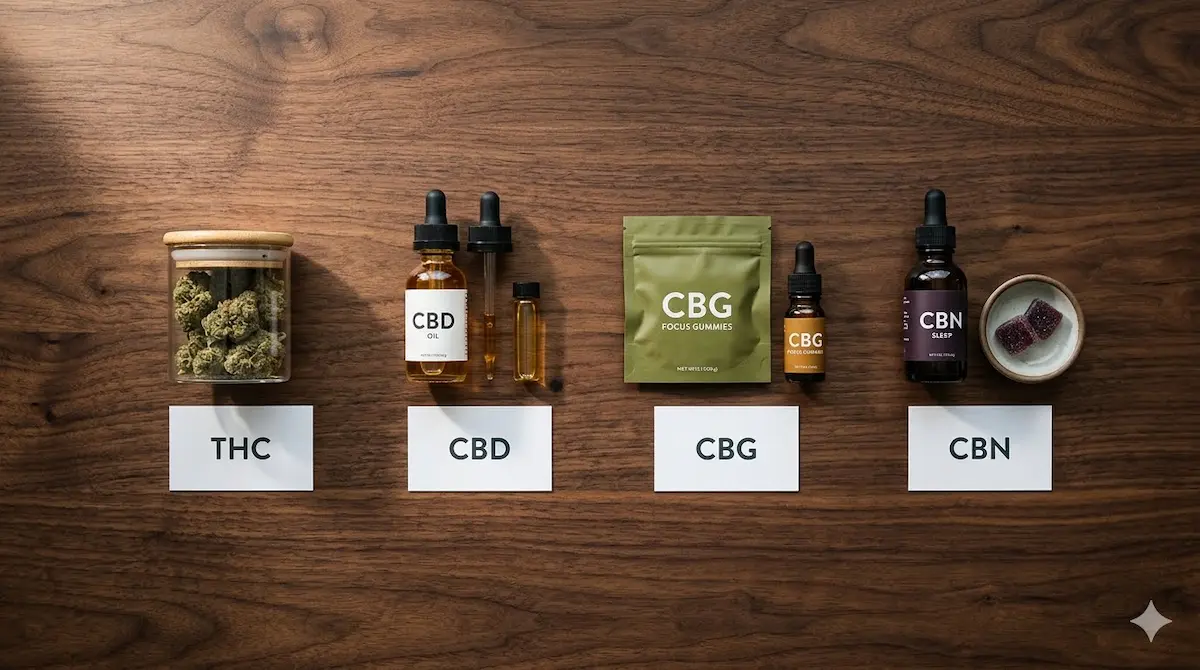
Cannabinoids are natural compounds found in the cannabis plant. Over a hundred of them exist, but only a handful matter for everyday buyers. Four of those — THC, CBD, CBG, and CBN — drive almost every effect you’ll feel from a cannabis product.
The four cannabinoids that matter most
Your body already runs on a system called the endocannabinoid system. Cannabinoids from cannabis interact with that system in different ways. As a result, some make you feel high. Others calm you down. A few sharpen your focus. One in particular helps you fall asleep.
The trick isn’t memorizing the science. Rather, it’s knowing which cannabinoid does what — and how to spot it on a label.
How cannabinoids work in plain English
Think of your body as a building with locks on certain doors. Cannabinoids are the keys. Each cannabinoid fits a slightly different lock, which is why each one produces a slightly different effect. THC unlocks the “high” door. CBD calms things down. CBG turns on focus. CBN ushers in sleep.
That’s the whole framework. Everything else in this guide builds on those four keys.
THC: The Famous One
THC stands for tetrahydrocannabinol, and it’s the cannabinoid responsible for the “high” most people associate with cannabis. When someone talks about getting buzzed, lifted, or stoned, they’re talking about THC.
What THC does
THC binds directly to the receptors in your brain that control mood, appetite, perception, and pain. Within minutes (when smoked or vaped) or about an hour (when eaten), it produces euphoria, relaxation, hunger, and altered perception of time. Effects last anywhere from one to six hours depending on the product type.
Best for
- Recreational enjoyment and social use
- Strong pain relief
- Appetite stimulation
- Deep relaxation in the evening
- Creative or sensory experiences
Things to know before trying THC
THC is the cannabinoid most likely to cause side effects in new users. Higher doses can trigger anxiety, paranoia, or racing thoughts. Edibles hit harder and last longer than smoking or vaping. Always start with a low dose, especially if you’re new — half of what you think you need is often the right answer.
For LA-area customers, Moonrock weed delivery carries THC products across every category — flower, edibles, vapes, and concentrates.
CBD: The Calm Cannabinoid
CBD stands for cannabidiol. Unlike THC, CBD won’t get you high. Instead, it works quietly in the background, reducing stress, easing tension, and smoothing out the edges without altering your headspace.
What CBD does
CBD doesn’t bind to the same brain receptors as THC. As a result, it doesn’t produce euphoria or impairment. Rather, it interacts with the body’s stress-response systems and inflammation pathways. People who use CBD typically describe the effect as “taking the edge off” — calmer, looser, more at ease, but still fully clear-headed.
Best for
- Daytime anxiety and stress relief
- Mild pain and inflammation
- Recovery after exercise
- Sleep support (combined with other cannabinoids)
- Anyone who wants cannabis benefits without the high
Things to know about CBD
CBD is legal in most states and widely available, though potency and purity vary wildly between brands. Stick with licensed dispensary products that include lab test results. Effects build over time — meaning daily CBD users often report better results after a week or two of consistent use rather than from a single dose.
CBG: The Mother Cannabinoid
CBG stands for cannabigerol. It’s called the “mother cannabinoid” because almost every other cannabinoid (including THC and CBD) starts as CBG in the cannabis plant before chemically transforming during growth. As a result, finished cannabis usually contains very little CBG — which is why CBG-rich products are newer and rarer on dispensary shelves.
What CBG does
CBG produces a focused, clear-headed alertness. Many users describe it as “coffee without the jitters” or “Adderall-light.” Honestly, it doesn’t get you high. Instead, it sharpens attention and reduces background anxiety, which makes it useful for daytime tasks that require focus.
Best for
- Daytime focus and productivity
- Morning routines without caffeine jitters
- Mild stress relief while staying sharp
- Inflammation support
- Anyone who wants alert calm rather than sedation
Things to know about CBG
CBG is more expensive than THC or CBD because it’s harder to produce. Quality matters even more here — look for full-spectrum or CBG-isolate products from licensed dispensaries with verified lab results. Effects are subtle compared to THC, so don’t expect a dramatic feeling. Rather, expect a quiet sharpening of your focus.
CBN: The Sleep Cannabinoid
CBN stands for cannabinol. It forms when THC ages — meaning older cannabis naturally contains more CBN than fresh cannabis. As a result, CBN-rich products are typically designed and dosed specifically for sleep, recovery, and deep rest.
What CBN does
CBN produces a sedating, body-heavy effect that helps users fall asleep and stay asleep. Unlike THC, the head-high is minimal. Rather, the effect is closer to a melatonin-grade sleep aid combined with mild muscle relaxation. Most CBN products are blended with small amounts of THC to amplify the sedation through what’s called the entourage effect (more on that shortly).
Best for
- Falling asleep faster
- Staying asleep through the night
- Muscle relaxation before bed
- Winding down after high-stress days
- Recovery sleep after intense workouts
Things to know about CBN
CBN is best taken 30 to 60 minutes before bed. Higher doses produce stronger sedation, so beginners should start low — 2 to 5 mg is plenty for most people. Don’t combine CBN with alcohol or other sedatives. Morning grogginess is possible with higher doses, so adjust until you find your sweet spot.
THC vs CBD vs CBG vs CBN Explained: The Side-by-Side
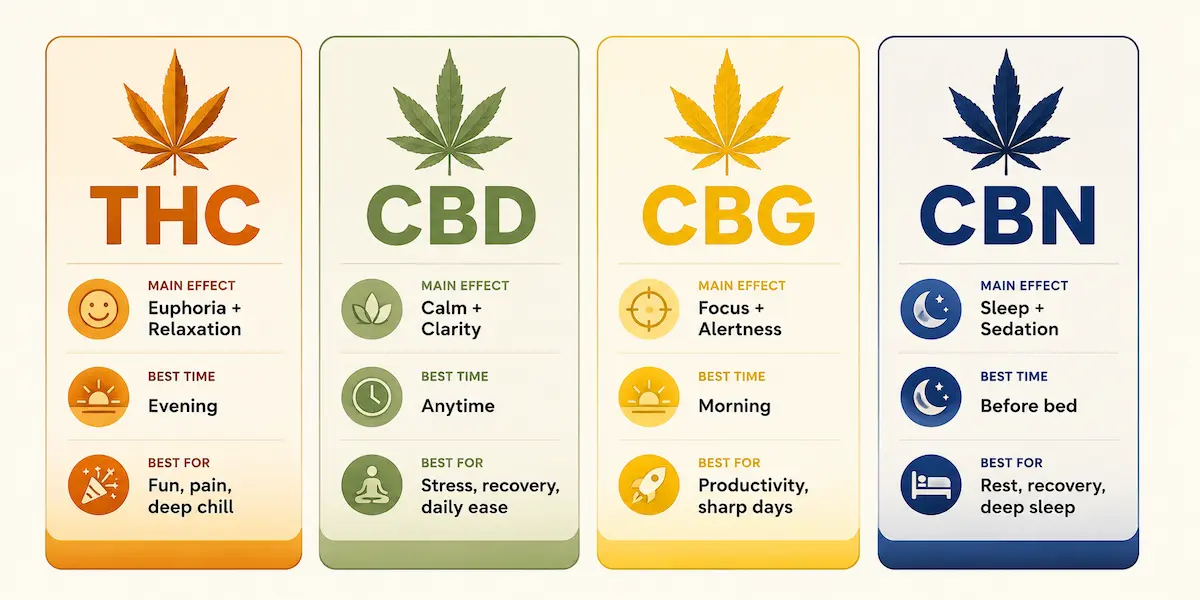
Here’s where the difference between THC CBD CBG CBN becomes crystal clear. The table below shows how all four cannabinoids stack up across the things customers actually care about.
| THC | CBD | CBG | CBN | |
|---|---|---|---|---|
| Gets you high? | Yes | No | No | Mild |
| Main effect | Euphoria + relaxation | Calm + clarity | Focus + alertness | Sleep + sedation |
| Best time to use | Evening or social | Anytime | Morning or workday | Before bed |
| Best for | Pain, fun, deep relaxation | Anxiety, recovery | Focus, productivity | Sleep, muscle relaxation |
| Side effect risk | Higher (anxiety, paranoia) | Very low | Low | Mild grogginess at high doses |
| Typical products | Flower, vapes, edibles | Tinctures, gummies, capsules | Tinctures, focused-blend edibles | Sleep gummies, tinctures, capsules |
| Beginner-friendly? | Yes, with low doses | Yes | Yes | Yes, with proper timing |
In short, that’s how THC vs CBD vs CBG vs CBN explained looks at a glance — a quick map you can return to anytime you’re staring at a dispensary menu.
Cannabinoid Effects and Benefits: Best for Your Goal
Now let’s flip the question. Instead of asking “what does this cannabinoid do?”, let’s ask “what cannabinoid should I pick for this specific goal?” Below is the cannabinoid effects and benefits breakdown organized around what most buyers actually want.
Best cannabinoid for sleep
Top pick: CBN, often blended with a small amount of THC.
CBN produces direct sedation. Adding 2-5 mg of THC amplifies the effect through the entourage interaction. Look for “sleep blend” gummies or tinctures with both. CBD alone is too mild for serious sleep issues for most people.
Best cannabinoid for focus
Top pick: CBG, sometimes paired with a low-dose THC.
CBG provides alert calm without the buzz. A small THC dose (1-2 mg) can enhance creativity without impairment. Stay away from CBN during work hours — it’ll put you under.
Best cannabinoid for anxiety
Top pick: CBD, often paired with low-dose THC.
CBD reduces anxious tension without the high. For acute anxiety, broad-spectrum tinctures act fastest. For ongoing daily stress, consistent CBD gummies or capsules work best. Avoid high-THC products if anxiety is your primary concern — they can worsen it.
Best cannabinoid for recovery and inflammation
Top pick: CBD plus CBG, with optional CBN at night.
CBD reduces inflammation. CBG supports recovery without sedation. CBN handles the deep recovery sleep. Topical CBD is excellent for localized muscle and joint pain.
Pro tip: Combining the right cannabinoids almost always works better than relying on just one. The entourage effect (covered next) is the reason why.
The Difference Between THC CBD CBG CBN in Real Products
Knowing what each cannabinoid does is half the battle. The other half is recognizing them on a dispensary menu. Here’s where the difference between THC CBD CBG CBN plays out across the products you’ll actually shop for.
In flower and pre-rolls
Most cannabis flower is THC-dominant. CBD-dominant flower exists but is less common. CBG flower is rare and usually premium-priced. CBN doesn’t appear in fresh flower in meaningful amounts — instead, it shows up in aged cannabis or in concentrates designed for sleep.
In edibles
Edibles offer the most variety. THC gummies are standard. CBD gummies and capsules are widely available. CBG edibles are growing in popularity for focus-oriented buyers. CBN sleep gummies (often blended with THC and melatonin) have become one of the fastest-growing product categories in dispensaries.
In vapes and concentrates
THC dominates the vape category. CBD vapes exist but are less common. CBG vapes are starting to appear for daytime use. CBN vapes are rare — the cannabinoid works better in slower-acting product types like edibles and tinctures.
For LA-area customers exploring vape options, our vape delivery in Los Angeles menu shows the full range across all four cannabinoids.
In tinctures and oils
Tinctures are where you’ll find the widest selection of CBD, CBG, and CBN — usually as single-cannabinoid products or as targeted blends like “Focus Formula” (CBG-heavy), “Calm Drops” (CBD-heavy), or “Sleep Blend” (CBN + THC). Tinctures absorb fast under the tongue, making them ideal for precision dosing.
How Cannabinoids Work Together: The Entourage Effect
Here’s something most beginner guides skip — and it changes how you should think about every cannabis product you buy.
Cannabinoids work better together than alone. That’s the entourage effect. When THC, CBD, CBG, and CBN appear in the same product (alongside terpenes — the aromatic compounds in cannabis), each one enhances the others. As a result, the combined effect is often stronger, smoother, and more balanced than any single cannabinoid taken alone.
That’s why “full-spectrum” and “broad-spectrum” products tend to outperform single-cannabinoid isolates for most goals. A CBD product that includes small amounts of THC, CBG, and CBN usually works better for anxiety than pure CBD isolate. A sleep gummy with CBN + THC + terpenes works better than CBN alone.
In practical terms: when shopping, lean toward full-spectrum products unless you have a specific reason to avoid THC entirely.
How to Choose Cannabinoid Products: A Buyer’s Framework
When customers ask how to choose cannabinoid products, the answer isn’t a single recommendation — it’s a framework. Use this three-step process every time you shop, and you’ll never pick wrong.
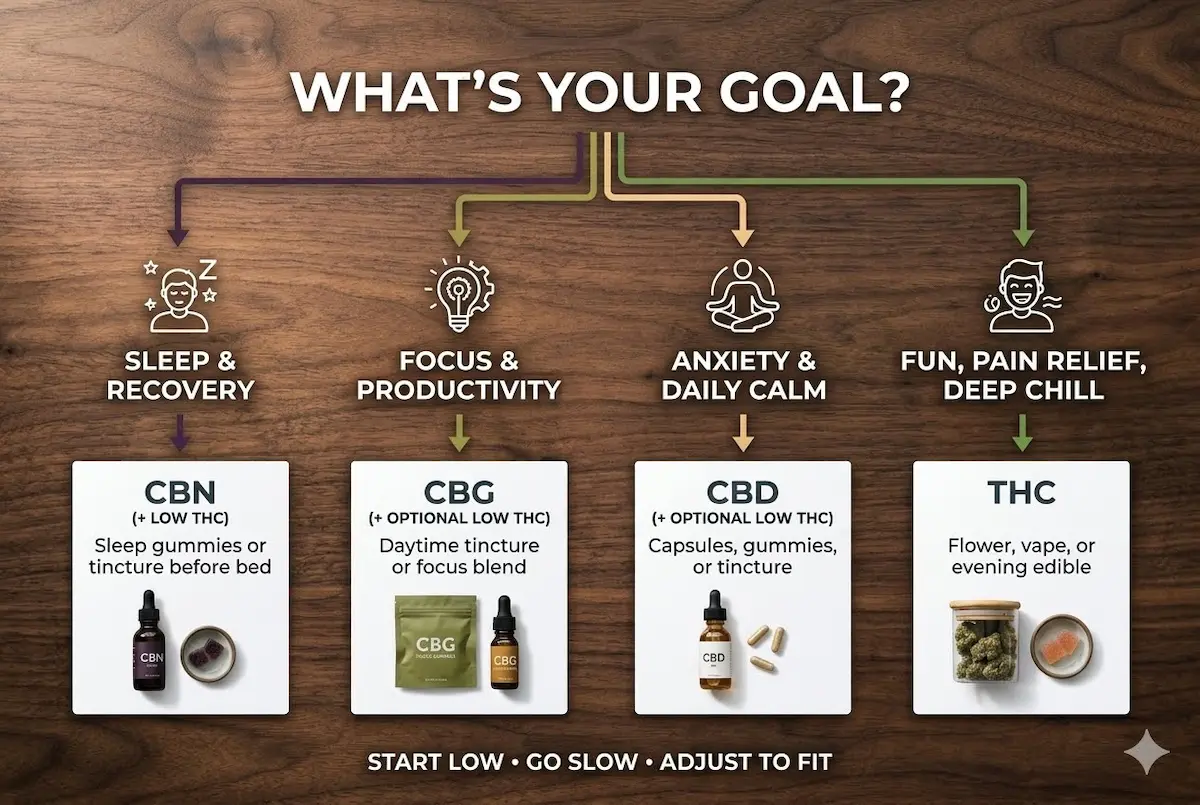
Step one: start with the goal, not the cannabinoid
Don’t open a menu thinking “I want THC” or “I want CBD.” Instead, open it thinking “I want to sleep better” or “I want to focus” or “I want to relax after work.” The goal tells you the cannabinoid, not the other way around.
Step two: match the product type to your routine
The same cannabinoid delivers very different experiences depending on the product. A THC vape hits in two minutes and fades in two hours. A THC edible takes an hour and lasts six. Pick the format that fits when and how you want the effect.
| Format | Onset | Duration | Best for |
|---|---|---|---|
| Vape / flower | 2–10 min | 1–3 hours | Quick effect, flexible timing |
| Edibles | 30–90 min | 4–8 hours | Long sessions, sleep, all-day relief |
| Tinctures | 15–45 min | 2–6 hours | Precision dosing, fast onset |
| Capsules | 30–90 min | 4–8 hours | Daily routines, consistent dosing |
| Topicals | 15–30 min | 2–4 hours | Localized pain, no high |
Step three: start low, go slow
This rule applies whether you’re new to cannabis or just new to a specific cannabinoid. Start with the lowest dose the product offers. Wait the full onset time. Adjust upward only after you’ve felt the baseline. Honestly, more people regret going too high than going too low.
Dosing Basics for Beginners
General dosing guidance for each cannabinoid (always start at the low end of the range):
| Cannabinoid | Beginner dose | Standard dose | Notes |
|---|---|---|---|
| THC | 1–2.5 mg | 5–10 mg | Edibles especially — start low |
| CBD | 10–25 mg | 25–50 mg | Higher doses are safe but expensive |
| CBG | 5–15 mg | 15–30 mg | Daytime use, subtle effect |
| CBN | 2–5 mg | 5–10 mg | Take 30–60 min before bed |
These ranges work for most adults but vary based on body weight, tolerance, and individual response. Tolerance builds with regular use — meaning you may need slightly more after weeks of daily intake.
Safety note: This dosing guide is general education, not medical advice. Talk to a healthcare provider if you have existing conditions or take medications. Always confirm you meet your state’s legal age requirement — our age verification matters for online cannabis orders piece explains the rules in detail.
Cannabinoid Legal Status: What Varies by State
Cannabinoid legality is far from uniform across the United States. THC remains federally restricted but is legal recreationally in many states and medically in most. CBD derived from hemp is federally legal under the 2018 Farm Bill, though states regulate it differently. CBG follows the same rules as CBD when hemp-derived. CBN sits in a gray area — most CBN products derive from hemp and follow CBD rules, but check your state’s specifics before ordering.
In California, the Department of Cannabis Control regulates all dispensary sales — THC, CBD, CBG, and CBN included. For a broader scientific look at cannabinoids and their effects, the National Library of Medicine maintains the most reliable peer-reviewed cannabinoid research available.
When in doubt, ask your local dispensary. They’ll know exactly what’s legal where you live and can guide you to compliant products.
Frequently Asked Questions
What are the four main cannabinoids?
THC, CBD, CBG, and CBN. These four drive almost every effect cannabis customers feel — from euphoria and relaxation to focus and sleep.
Which cannabinoid is best for sleep?
CBN, ideally blended with a small amount of THC. Most “sleep gummies” on dispensary shelves combine these two for the strongest sedative effect.
Is CBG psychoactive?
No. CBG doesn’t produce a high. Instead, it creates alert calm — useful for focus and productivity during the day.
Does CBN make you high?
Mild. CBN has minimal psychoactive effect on its own. The “heaviness” you feel from CBN products usually comes from added THC in the blend.
Can you take THC, CBD, CBG, and CBN together?
Yes — and many products are designed to combine them. The entourage effect means combined cannabinoids often work better than any single one alone.
What’s the difference between THC and CBD?
THC gets you high; CBD doesn’t. THC binds directly to brain receptors that control mood and perception. CBD interacts with the body’s stress and inflammation systems without altering headspace.
Is CBG stronger than CBD?
Not necessarily stronger — different. CBG produces alertness and focus. CBD produces calm. Honestly, neither is “stronger” in absolute terms; they do different jobs.
What cannabinoid helps with focus?
CBG is the most focus-oriented cannabinoid. Some users also report mild focus from low-dose THC paired with CBD, but CBG is the cleanest choice for daytime productivity.
Which cannabinoid is most relaxing?
For relaxation without sedation: CBD. For relaxation with mild euphoria aswell as THCFor relaxation that leads to sleep: CBN. Pick based on whether you want to stay alert or wind down.
Are CBG and CBN legal in all states?
Generally yes when derived from hemp, but state rules vary. Check your local cannabis regulator or ask your dispensary for the current status where you live.
Can I combine cannabinoid products with prescription medications?
Always check with your healthcare provider first. Cannabinoids can interact with certain medications, particularly blood thinners, sedatives, and some antidepressants.
How long do cannabinoid effects last?
THC: 1-6 hours depending on product type. CBD: 2-6 hours. CBG: 2-4 hours. CBN: 4-8 hours, especially when used for sleep.
The Bottom Line: Choosing the Right Cannabinoid for You
Here’s the whole guide in one paragraph. THC gets you high and works for fun, pain, and deep relaxation. CBD calms you down without the high and supports daytime stress relief. CBG sharpens your focus while keeping you steady. CBN guides you into sleep when nothing else does. Combined intelligently — the entourage effect — they outperform any single cannabinoid alone.
Honestly, the THC CBD CBG CBN guide isn’t about memorizing facts. Rather, it’s about matching the right cannabinoid to the right goal at the right moment. Once you’ve got the framework, every dispensary menu becomes readable. Every label makes sense. Every purchase fits the result you actually want.
Ready to put this knowledge to work? Browse weed delivery near me in Los Angeles and pick the cannabinoid that fits your next goal — co