No products in the cart.
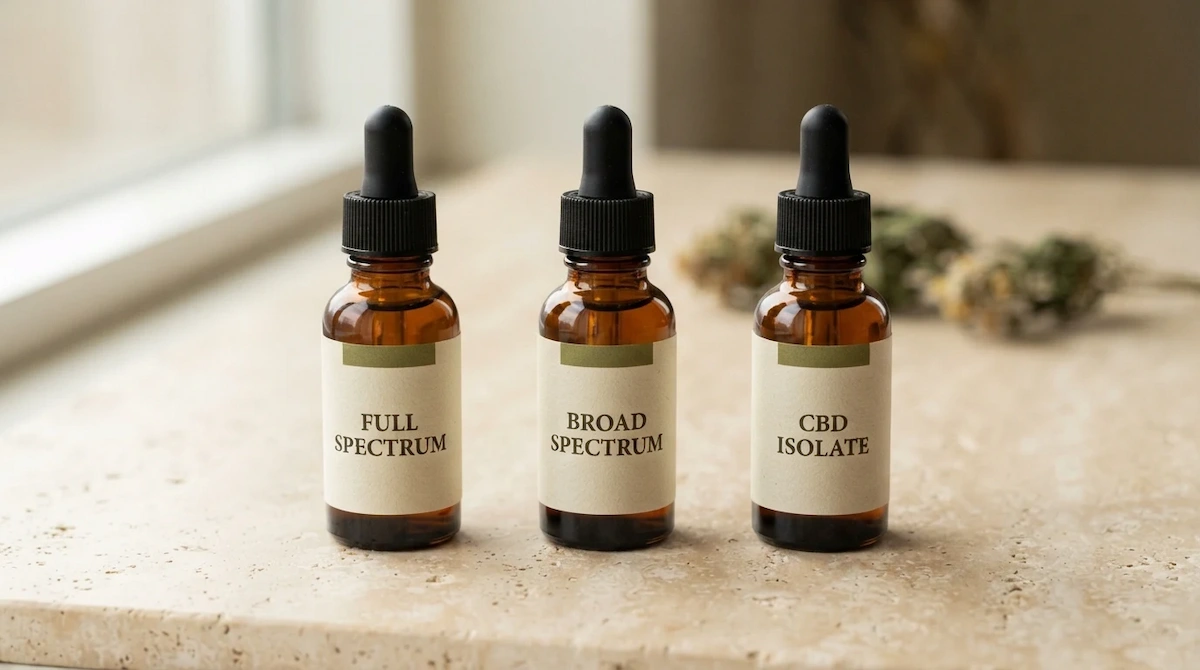
Two bottles of CBD oil can both say 1,000 mg and contain different cannabinoid profiles. One may contain CBD alongside measurable THC and other cannabinoids. Another may retain several compounds while listing THC below a lab’s reporting threshold. A third may use purified CBD as its cannabinoid ingredient. When you compare full spectrum vs broad spectrum, start with the type of extract. Then check the CBD concentration, the other ingredients, and the lab report for the specific bottle.
The word spectrum describes the range of compounds in the extract. Bottle strength answers a separate question: how much CBD does the label say you’re getting? You can compare the spectrum, the strength, and the serving size even when two brands put different information on the front of their packages. This guide explains each label and shows how to put the numbers on the same basis.
Full Spectrum vs Broad Spectrum at a Glance
| Extract type | What the term generally describes | What to check |
|---|---|---|
| Full-spectrum CBD | CBD alongside other cannabis compounds, which can include THC | CBD concentration and the measured cannabinoid profile |
| Broad-spectrum CBD | CBD with other compounds, generally formulated to remove or limit detectable THC | The specific THC results and the lab’s reporting thresholds |
| CBD isolate | Purified cannabidiol used as the cannabinoid ingredient | The finished formula, CBD per serving, and batch results |
Use the spectrum label to understand the manufacturer’s description, then check the results for the sample the lab actually tested. In a 2024 study of 202 commercial CBD products, researchers found that 149 measured more than 10 percent above or below the CBD amount on the label. That finding applies to the products they tested. It illustrates why a batch report is worth looking for if you’re comparing precise amounts. Read the product labeling study.
What Is Full-Spectrum CBD Oil?
A full-spectrum CBD oil usually combines a CBD-containing cannabis extract with a carrier oil. The extract can include other cannabinoids alongside CBD. Depending on the product and batch, a report might list cannabinoids such as CBG, CBC, or THC. The ingredient list gives you the broader formula, including the carrier and any added flavor. Those two documents give you different details about the same bottle.
A full-spectrum label describes the extract, while a milligram figure describes an amount. Two products can both use full-spectrum extracts and have different CBD concentrations. They might also differ in how much THC the lab measured. To compare them, find the CBD number, read the bottle volume, and check what the cannabinoid panel says about the relevant lot.
The carrier can matter if you have an ingredient preference or want to avoid a specific oil. It can also help explain why two products have different textures or flavors despite using the same spectrum term. If flavoring is listed separately, read that part of the ingredient list. The extract description and the carrier description identify different parts of the finished product.
Before You Buy Full Spectrum CBD Oil
When you open a product page, select the strength you want to compare. Look for an amount explicitly labeled CBD, the full bottle volume, and a serving size expressed as a measured amount of liquid. If a report is available, check whether it covers the selected option or only one version of the product. A picture of a similar bottle can help you recognize the package, but use the label and batch identifiers for a precise comparison.
Our Full-Spectrum CBD Oil Drops are one example from the catalog. If you’re comparing those drops with another oil, note the specific strength listed for each bottle. A large number on the front of a package can be easy to remember, but bottle volume gives that number context. Compare the oils using the amount of CBD in each milliliter once you have both figures.
What Is Broad-Spectrum CBD?
Broad-spectrum CBD generally describes a product with CBD and other cannabis compounds that is formulated to remove or limit detectable THC. The name can help you narrow down a comparison. If your decision depends on the measured composition, check which cannabinoids the lab includes and how it reports the results. Research on commercially available tinctures has found discrepancies in CBD and THC labeling. Read the study on CBD tincture labeling.
A broad-spectrum report may show several measured compounds and a row for delta-9 THC. Read the whole row, including the unit and any symbol next to the result. A less-than sign or a notation such as ND may need the report legend to make sense. The number written beside a threshold tells you something about the scale the lab used, so keep that threshold with the result when comparing documents.
How to Compare Two Broad-Spectrum Labels
Take the two product labels and find the exact same fields on each. Start with the bottle volume and the amount labeled CBD. Then compare the carrier and other ingredients. Finally, open each batch report and identify the named cannabinoids the lab measured. If a product has a long table, look at the results alongside the names. A long panel can include entries that fall below reporting limits.
If you have only one report, you can still compare the written product claims side by side. Make a note of which details come from the label and which come from the measured results. This keeps you from comparing a claim on one package with a test result for another and assuming both numbers carry the same meaning. It also tells you exactly what to ask for if you want more information about the second bottle.
What Is CBD Isolate?
CBD isolate is purified cannabidiol. In a finished isolate oil, it serves as the cannabinoid ingredient. A carrier oil makes up the liquid formula, and some products may include other listed ingredients such as flavoring. This is why an oil described as isolate can still have more than one ingredient. The word isolate refers to the type of CBD ingredient used in the formula.
Our Premium CBD Isolate Oil is the isolate example in the catalog. If you’re comparing CBD isolate oil for sale with full-spectrum drops, start with the amount of CBD per milliliter, then read both ingredient lists. That lets you compare strength on a common basis before considering which extract type or carrier you prefer.
Isolate Powder and Isolate Oil Use Different Units
An isolate powder may list a net weight in grams. An isolate oil may list milligrams of CBD in a bottle and the volume of oil in milliliters. Grams tell you mass. Milliliters tell you volume. Before comparing the numbers, identify the product format and what each figure measures. A powder’s package weight and an oil’s volume give you different information, even when both product names include the same word.
With two finished oils, use their CBD concentration for a direct comparison. With a finished oil and a powder, use the label to understand each separately. If a number applies to the raw material, keep it with the raw material. A report for an ingredient can support information about that ingredient while leaving questions open about the finished bottle.
Reading CBD Strength on the Bottle
Start with the number explicitly identified as CBD. The front of the package might highlight total CBD, total hemp extract, or a figure for a serving. Sometimes more than one number appears on the same label. Read the description beside each amount and write down the unit. A clear comparison begins when you know exactly what the numbers refer to.
Next, find the total liquid volume. Divide the labeled milligrams of CBD by the milliliters in the bottle. A 1,000 mg bottle containing 30 mL has about 33.3 mg of CBD per mL. A 1,000 mg bottle containing 60 mL has about 16.7 mg per mL. Both labels give the same amount for the whole package. The smaller bottle has the higher concentration in this example.
| Example bottle | Total CBD | Bottle volume | CBD per mL |
|---|---|---|---|
| Oil A | 1,000 mg | 30 mL | About 33.3 mg |
| Oil B | 1,000 mg | 60 mL | About 16.7 mg |
| Oil C | 500 mg | 15 mL | About 33.3 mg |
Oil A and Oil C have the same labeled concentration. Oil A contains twice the liquid and twice the total amount of CBD. This example shows why the number on the front and the bottle size both matter. The figures describe hypothetical labels and let you practice the calculation before applying it to actual listings.
Compare the Labeled Serving Sizes
Compare the volume of each labeled serving as well as the stated CBD per serving. Suppose two oils have 20 mg per mL. One labels a 0.5 mL serving as 10 mg of CBD. The other labels a 1 mL serving as 20 mg of CBD. The amount per serving changes because the serving volumes differ. The oils have the same concentration in that example.
Check the dropper markings when the instructions identify a measured amount. If the package describes a serving as a dropperful, look for an equivalent volume in milliliters. This makes the label easier to compare with one that specifies a measured volume. The calculation is a way to compare labels and their units. Follow the product’s directions for handling and consult a healthcare professional about personal use when appropriate.
Compare Cost Using the Same Unit
A $30 bottle containing 600 mg of labeled CBD and a $50 bottle containing 1,000 mg both cost 5 cents per labeled milligram. That calculation measures the price of the stated CBD amount. Two products can have the same cost per labeled milligram and different carriers, spectra, or documentation, so compare those details on their own merits.
You can also look at the total cost of the package you want, especially if you’re choosing between sizes. The price per milligram helps when the question is how much each product costs for its stated CBD content. The sticker price helps when the question is what you’ll pay for the entire bottle. Keep both figures handy when the two products are sold in different package sizes.
How to Read a CBD Batch Lab Report
A certificate of analysis, often called a COA, records the lab’s findings for the sample it tested. A report may contain a cannabinoid panel, and some reports also include separate panels for other substances. Look at the list of tests before assuming the document covers everything you’re interested in. A report that gives cannabinoid concentrations can answer questions about those measured compounds. Check the actual panels for any other result you want to review.
Match the Product and Lot
Start with the product name, strength, and lot or batch identifier. If you have the bottle, copy its code exactly and compare it with the code on the report. If you’re looking online, check which options the seller says the report covers. Two bottles can use the same label design while coming from different lots. The lot number gives you a more useful point of comparison than the label color or bottle shape.
Then confirm what the lab received. A report may identify the sample as a finished oil, a bulk extract, or a raw ingredient. If you’re trying to understand the bottle you’re buying, a report for that finished oil gives you the closest evidence. A report for a shared ingredient can still be informative when its scope is clear. Keep the sample description attached to any figure you record.
Read the Name, Result, and Unit Together
Find CBD by name and read across to the result. Look at the unit shown in the column header. A report in milligrams per gram and a label in milligrams per milliliter use different measures. To convert between them for a particular oil, you need its density or a documented conversion. If you can’t find that information, compare results reported in the same unit or ask for clarification.
The same habit helps with THC. A panel may list delta-9 THC, THCA, and a calculated total separately. Keep the compound named on the report with its result and unit. When you make notes, write down the sample name and lot as well. This keeps a result for one compound and sample from turning into a broad statement about a whole product line.
Check Reporting Limits and Test Dates
ND often means not detected, but use the lab’s legend to confirm the meaning for that report. A lab’s result is tied to the method and reporting limit it used. Reports may also list LOQ, meaning limit of quantitation. Keep the threshold and unit beside your notes when a report uses a less-than value. If the lab’s method or shorthand is unclear, contact the seller or lab to help interpret the specific document.
Look at the dates after you’ve confirmed the lot number. A report can show when the lab received the sample, when it tested the sample, or when it issued its findings. Those dates serve different purposes. The lot is the detail that ties the report to the bottle. If several documents are available, choose the one that identifies the strength and batch you’re interested in.
Does CBD Have THC?
A CBD product can contain THC, depending on its formulation. Full-spectrum products can include measured THC. Broad-spectrum and isolate describe other approaches to the extract or ingredient, and the report for the finished product can show which THC compounds the lab found. If you’re comparing two concentrations, review the corresponding report for each option. Commercial product testing has found that product claims and measured results can differ. See the published tincture study.
Does CBD Contain THC if the Bottle Says THC-Free?
Read the exact claim and check how the company supports it. For a lab report, note the compound the lab tested and whether it reported a number or a result below a threshold. If a report gives a result for delta-9 THC, keep your conclusion specific to that line. The panel and its thresholds tell you the scope of the evidence and give you a better starting point for comparing claims across products.
Check the package and report together if THC exposure has consequences for you. A document for a different batch or a raw ingredient may leave the question unanswered for the finished oil. If you’re subject to an employer, sport, or other testing program, ask the organization how it interprets its own policy before relying on a product description.
Does CBD Show Up on a Drug Test?
The answer depends on what the test measures and what the product contains. A CBD product containing THC can contribute to a positive result on a THC test. In a controlled study, researchers observed positive urine tests in some participants who took CBD oil containing low amounts of delta-9 THC. The study reported results for the formulations and participants it examined. Read the controlled CBD and THC study.
Can CBD Make You Fail a Drug Test?
A product that also contains THC can create that risk. A batch report can tell you what a lab measured in a particular sample. It cannot guarantee an individual test outcome. Exposure, timing, test method, and cutoff can affect results. If a test result carries serious consequences, ask the testing organization which compounds it screens for and what its policy requires.
Can CBD Interact With Medication?
The FDA identifies potential medication interactions and other risks associated with CBD. If you take medication or have a health condition, discuss the specific product with a healthcare professional. The ingredient list and product label give them concrete details to review. Read the FDA’s consumer information on CBD.
Comparing Three Hypothetical Bottles
Imagine three 30 mL oils that each list 600 mg of CBD. One says full-spectrum, one says broad-spectrum, and one says isolate. All three list 20 mg of CBD per milliliter when you divide the bottle total by the bottle volume. This comparison establishes their stated CBD concentration before you look at anything else.
Now compare the ingredient lists. If two oils use the carrier you prefer and one includes a flavor you want to avoid, you have a practical distinction already. Then open the batch reports. The full-spectrum example could show CBD, other cannabinoids, and a measurable THC result. The broad-spectrum example could show CBD and other cannabinoids with delta-9 THC below the reporting threshold. The isolate example could show CBD with the other measured compounds below the lab’s limits.
Finally, compare the labeled serving volumes. If one label gives a serving of 1 mL and another gives 0.5 mL, the numbers per serving can differ even though all three examples have the same concentration. If you’re comparing composition, the reports give you another dimension to look at. If you’re comparing price and strength, the concentration and package total let you put the bottles on equal terms.
How to Compare CBD Oils When Details Are Missing
Product pages vary in how much information they show up front. If a listing gives the bottle total but leaves out the bottle volume, check the visible package label and the option selector. Sometimes the size is printed on the bottle image or listed with the selected strength. If you find the volume in one place and the CBD total in another, confirm both apply to the same option before calculating concentration.
A missing batch report calls for a different approach. Start by noting what you can confirm from the listing, such as the stated spectrum, package size, and ingredients. Then identify what you want the report to answer. If you want to compare THC results, ask for the finished-product cannabinoid panel and the code that connects it to the batch. If you want to compare CBD strength, ask for the measured result and its unit. A specific question makes it easier to recognize whether the answer covers the product you’re considering.
A Checklist for Comparing Two Listings
Write down the exact name of each product and its selected option. Record the bottle volume and the labeled CBD total. Calculate the concentration if both figures are available. Next, note the serving volume, carrier, and spectrum wording. If you have a batch report, record the lot number and the specific results you’re comparing. Keep a blank field when a detail is missing so you can see which questions remain open.
That same checklist works if you return to a listing later. A manufacturer can update its package or publish a report for a new lot. Checking the identifiers again gives you a way to see whether you’re still comparing the same bottle. If you saved a report, keep the product name and lot number with it so you can distinguish it from another report with a similar file name.
Frequently Asked Questions
Is a Bigger CBD Number Always a Stronger Oil?
Check the bottle volume. A 1,500 mg amount in 60 mL gives a concentration of 25 mg per mL. A 1,000 mg amount in 30 mL gives about 33.3 mg per mL. The first bottle contains more CBD overall. The second has more in each milliliter. Which number is useful depends on whether you’re comparing total quantity or concentration.
Is Hemp Seed Oil the Same Thing as CBD Oil?
Read the ingredient list and look for an explicit amount of CBD. Hemp seed oil can appear as a carrier in a formula, while a CBD amount describes the cannabinoid. If the label lists only hemp seed oil and gives no CBD amount, there is no stated CBD concentration to compare with a bottle sold as CBD oil. The ingredient name and the strength statement answer separate questions.
Do Gummies and Drinks Use the Same Terms?
CBD products in other formats can also carry spectrum labels. If you’re comparing a gummy and a drink, start with the amount of CBD per serving and the servings in each package. A gummy serving may contain multiple pieces. A bottle or can may also contain more than one labeled serving. Compare the same unit before deciding whether one package contains more CBD than the other.
Where Should I Look if a Product Has Several Strengths?
Select the exact option you want to compare and check that the label, bottle volume, and report all refer to it. A link to a batch report may appear near the product details or on a separate page. If that document covers another strength, use it to understand how results are presented and look for the report for the option you selected.
Conclusion
In a full spectrum vs broad spectrum comparison, the spectrum name is the starting point. It tells you how the extract is described. The ingredient list explains the finished formula. The measured cannabinoid results tell you what the lab found in a documented sample. Include CBD isolate if you want to compare a formula made with purified CBD as its cannabinoid ingredient.
Start with the actual bottles you’re considering. Compare the CBD concentration, check the serving size and carrier, and match any batch report to the strength and lot. If you’re comparing THC results, read the compound name and reporting threshold alongside the number. Those steps give you a usable comparison, even when different labels emphasize different details.